Viking Range Burner Clicks But Will Not Light
| This guide | Fault Guides |
|---|---|
| Appliance | Viking Range Repair |
| Written by | Hollis Yamada |
| Role | Service technician — refrigeration and cooking |
| In the trade | 21 years in the trade |
| Reading time | 5 min |
| If it needs a visit | $89, credited to the repair |
Endless ticking with no flame is rarely a dead igniter on its own. What the sound means on a Viking sealed burner, the short checks that settle most cases, and the point where it becomes a service call.
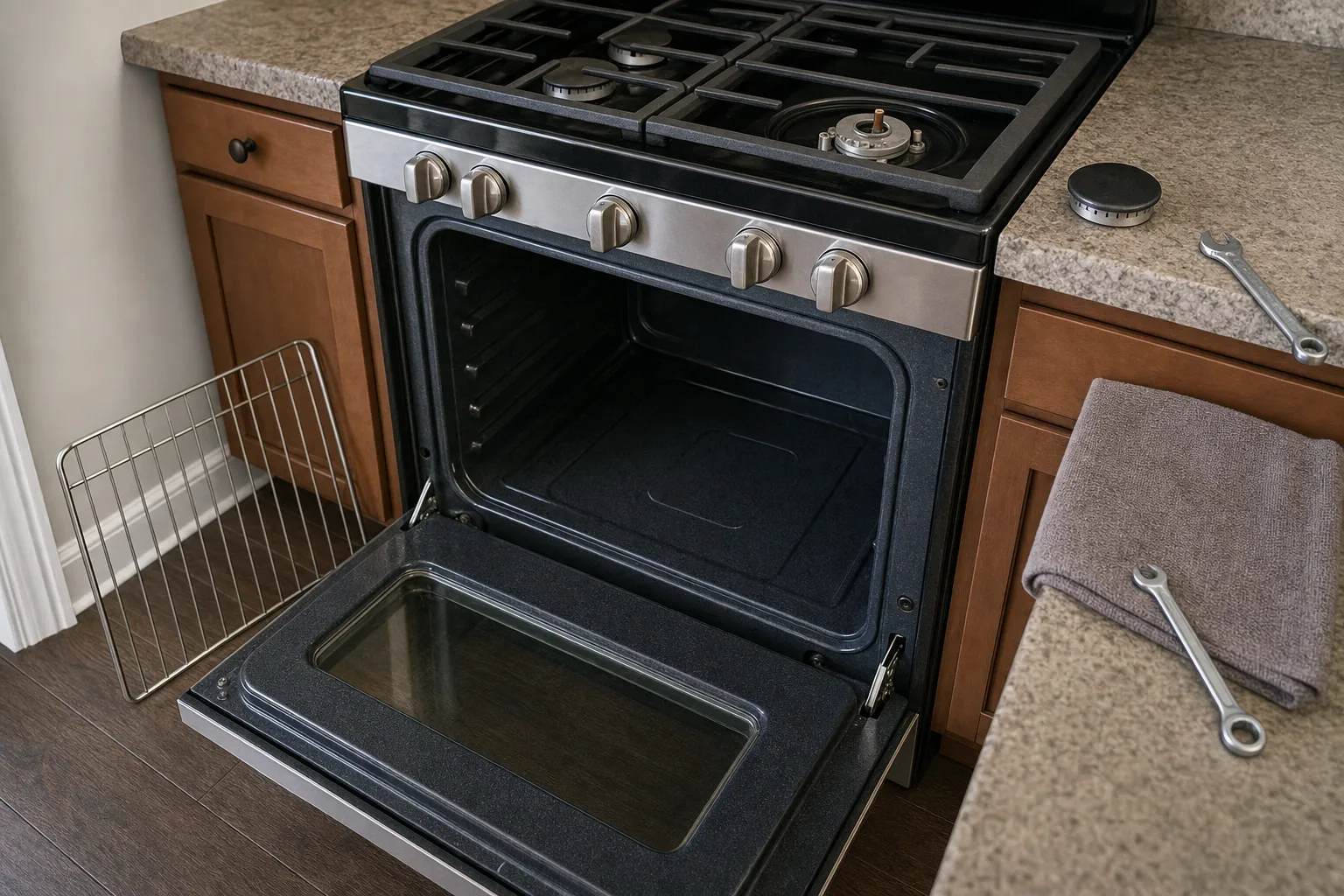
Ticking with no flame is one of the easiest Viking range faults to get wrong. It is natural to decide the igniter is dead. Often it is not, and the actual cause is something that costs nothing to correct — or something that a replacement igniter would not have fixed anyway.
One thing first: a smell of gas in the house is not a repair booking. Get everyone out, and ring the gas company or 911 from the street; switches and phones stay untouched until you are outside.
What the clicking actually is
The click is a spark electrode firing. On a Viking sealed-burner range the electrode sits at the edge of the burner base, and when you push and turn the knob two things happen at once: the gas valve opens, and the spark module starts firing the electrodes.
On most of these ranges every electrode fires together. That is normal and it surprises people constantly — you turn on the right rear burner and hear clicking from all four positions. The burner whose valve is open is the one that lights. Once flame is established, the flame-sense circuit sees it and the clicking stops.
So there are three separate things that can go wrong, and they produce the same noise:
- gas is not reaching the burner properly
- spark is happening but not in the right place, or not strongly enough
- flame is being established but the range cannot sense it, so it keeps sparking
That third one is the reason “buy a new igniter” is such a frequent and expensive mistake. A burner that lights and then keeps clicking anyway is not an ignition problem at all.
The five-minute checks that solve most of them
Before anyone gets called out, do these with the range off and cool.
Look at the burner cap. Lift it off and put it back deliberately. Viking caps sit in a specific orientation and a cap set down a few millimetres off-centre will block the port nearest the electrode. The burner then lights late, unevenly, or not at all. It is the first thing to rule out, and it is free.
Check for moisture. A boil-over, an enthusiastic wipe-down, or a cleaning spray that ran into the burner base will stop ignition dead. Dry it thoroughly — overnight with the cap off if it was a real spill — before you conclude anything is broken.
Clear the ports. Hold the burner head up to the light. The small holes around the rim should all be open. Carbonised spillover blocks them, and a burner with half its ports blocked will not carry flame around the ring even after it lights at the electrode. A pin or a fine wire clears them. Do not use a wooden toothpick that can snap off inside.
Look at the electrode itself. It should be dry, clean and not visibly cracked in its ceramic sleeve. A cracked sleeve leaks spark to the burner body instead of across the gap, and that shows up as weak or intermittent clicking.
If the range has just been moved, cleaned, or had a large spill, go through these before assuming a part has failed. A good many of these calls end there.
When one burner clicks and the rest are fine
This is the useful diagnostic split, and it is worth doing before you call anyone.
If one burner will not light while the others do, the shared parts are working — the spark module is firing, gas is present at the manifold, the supply is on. The fault is local to that burner: its cap, its ports, its electrode, or its individual valve. That is usually a modest repair.
If no burner lights but they all click, the spark side is alive and gas delivery is the suspect. Check whether other gas appliances in the house are working. A supply that was shut off for work elsewhere, or a valve left part-closed after the range was moved, shows up exactly like this; the valve itself is for the visit or the gas company, not something to turn yourself.
If nothing clicks at all, it is electrical. The range needs power for the spark module even though the burners are gas. Check the outlet and the breaker before anything else.
Yellow flames are a different problem
Occasionally what gets described as “will not light” turns out to be a burner that lights but burns badly — lazy yellow-orange flame, sooting on the pan bottoms, a smell while cooking. That is not an ignition fault and a new igniter will do nothing for it.
Yellow flame means the air-to-gas mixture is wrong: blocked ports, a burner cap seated incorrectly, debris in the venturi, or an air shutter adjustment that has drifted. On a range converted between natural gas and propane it can also mean the conversion was done incompletely — wrong orifices, or the regulator never switched over.
A correctly running Viking burner is blue with a crisp cone. Sustained yellow is worth getting looked at, both because it is inefficient and because incomplete combustion is not something to live with in a kitchen.
When it is genuinely a service call
Call someone if the checks above have not moved it and any of the following is true: the burner lights but the clicking never stops; the clicking is weak, irregular, or absent on one position while others spark normally; you can hear gas flowing with no ignition after several seconds; or the burner lights and then dies as soon as you release the knob.
That last one is worth flagging specifically: it points past the igniter, at the parts that keep a burner lit, and it is not something to guess at. The same applies to a range where flames have started lifting off the burner or burning back with a roar.
For what it is worth, on the Tacoma calls we run, the parts that actually get replaced for this symptom are, in order: nothing at all (cleaning and reseating), a single spark electrode, the spark module, and occasionally an individual burner valve. A whole-burner assembly replacement is rare. If someone quotes you for one without having taken the cap off first, get a second opinion.
Asked after reading this
Can I keep cooking on the other burners while this one ticks?
If a burner catches within a few seconds and the ticking then stops, carry on. If gas is flowing and nothing catches, turn that knob off, let the kitchen air out, and leave that burner alone until it has been checked. Unlit gas is the one part of this fault that matters for safety.
I turned on one burner, so why is every electrode ticking?
Because on a typical sealed-burner range the electrodes hang off one shared spark module, so they fire as a set, and only the burner with gas flowing catches. Hearing all of them is expected. The fault is ticking that carries on after the flame is up, or ticking with no flame.
Is it all right to clean the electrode myself?
Yes, gently and dry: range off and cool, a soft dry brush around the electrode, a pin through blocked burner ports. Do not soak it or let water run into the burner base, because damp in there is one of the usual reasons for this fault. Viking Repair Tacoma can take it from there on (206) 472-1140.